Notion Blog Setup: Publish from Notion to WordPress (2026)
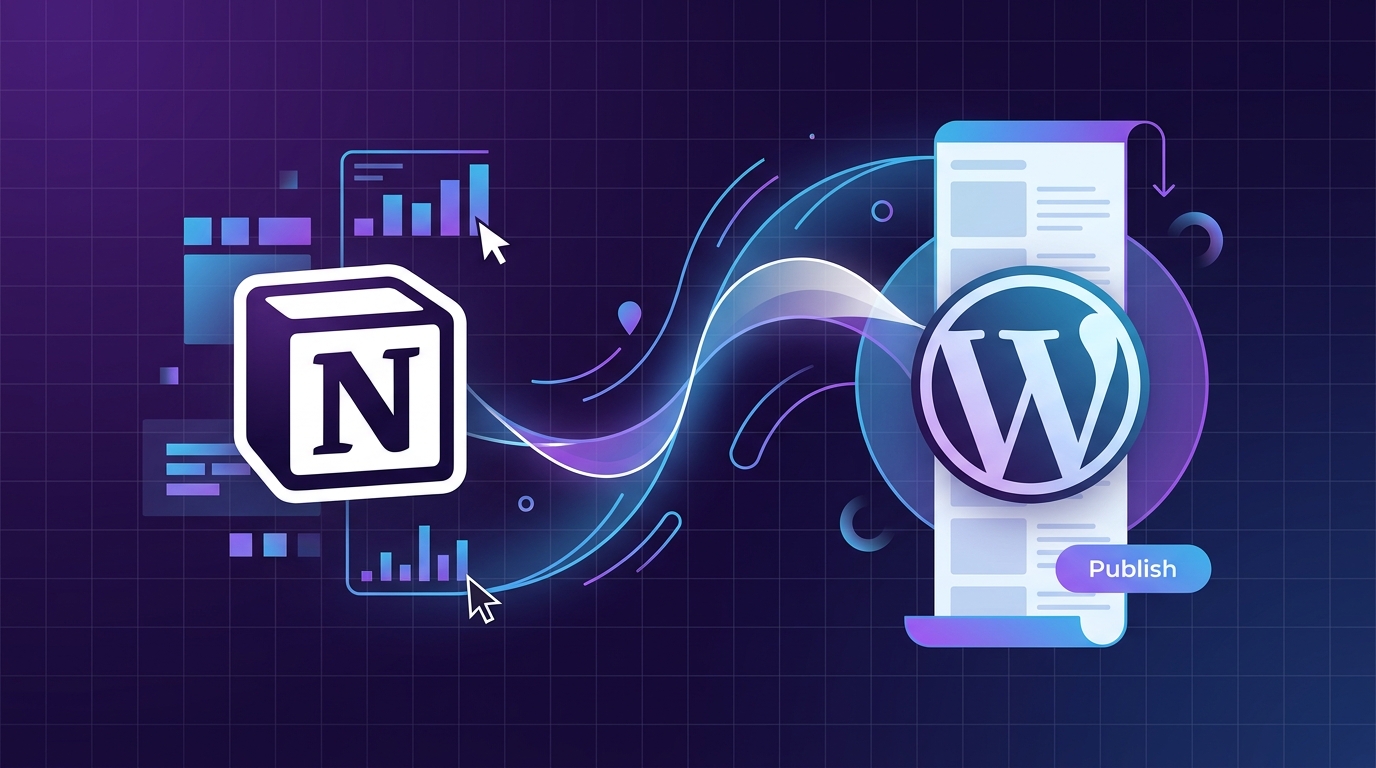
Notion is one of the best writing tools available. Markdown-style formatting, nested pages, databases with properties, drag-and-drop images — it's where most writers already draft their content. But a Notion blog published through “Share to Web” has serious limitations: no custom domain, no SEO control, no analytics, and Google rarely indexes Notion pages.
The better approach: use Notion as your writing tool and WordPress as your publishing platform. Write in Notion, sync to WordPress automatically, and get the best of both.
Why Notion Alone Isn't Enough for a Blog
Notion's Share to Web feature turns any page into a public URL. It works for sharing a single document. It does not work for running a blog. Here's what you lose:
- No custom domain — your blog lives on a notion.site subdomain you don't control
- No meta descriptions — you can't set the snippet that appears in Google search results
- No focus keywords — there's no way to tell search engines what your page is about
- No analytics — no Google Analytics, no Search Console, no conversion tracking
- No structured URLs — Notion URLs are random IDs, not human-readable slugs
- Slow indexing — Google deprioritizes Notion pages because they render client-side and lack standard SEO signals
Third-party tools like Super.so and Potion.so can wrap Notion pages in a custom domain, but they still inherit Notion's SEO limitations. You're paying for a wrapper around a system that wasn't designed for publishing.
The Notion Blog Stack That Works
The pattern used by content teams and solo bloggers who want Notion's writing experience with real SEO results:
- Notion — your content database. Each blog post is a page with properties for title, slug, category, tags, SEO keyword, and meta description.
- WordPress — your publishing platform. Custom domain, SEO plugins (Rank Math, Yoast, SEOPress, All in One SEO), themes, analytics, full control.
- Sync tool — connects the two. Watches your Notion database for status changes and pushes content to WordPress via the REST API. Handles images, formatting, SEO metadata, and featured images automatically.
The result: you write in Notion. You never open the WordPress editor. Posts go live when you change the status property in your Notion database.
Setting Up Your Notion Blog Database
Create a Notion database with these properties. Each property maps directly to a WordPress field during sync:
- Title — the post title (also used as the WordPress post title)
- Status (select) — Draft, Review, Publish. Changing to “Publish” triggers the sync.
- Slug (text) — the URL path. “notion-blog” becomes yourdomain.com/notion-blog
- Category (select) — maps to WordPress categories
- Tags (multi-select) — maps to WordPress tags
- SEO Keyword (text) — the focus keyword written to your SEO plugin
- Meta Description (text) — the snippet shown in Google search results
Notipo provides a pre-built template with all these properties configured. Duplicate it into your workspace and start writing immediately.
Connecting Notion to WordPress
The connection takes under 10 minutes:
- Create a free Notipo account at notipo.com
- Connect Notion — one-click OAuth authorization. No API tokens to copy.
- Connect WordPress — enter your site URL and create an application password in wp-admin. Notipo validates the connection before saving.
- Write and publish — create a post in Notion, fill in the properties, change status to Publish. The post appears on your WordPress site within minutes.
What Gets Synced Automatically
When you publish a Notion blog post through Notipo, the sync handles everything you'd normally do manually in the WordPress editor:
- Content formatting — headings, lists, code blocks, callouts, and quotes convert to proper Gutenberg blocks
- Images — downloaded from Notion (where S3 URLs expire in about an hour) and uploaded permanently to your WordPress media library
- SEO metadata — focus keyword and meta description written to your SEO plugin ( Rank Math, Yoast, SEOPress, or All in One SEO)
- Featured images — generated automatically with title text overlay. AI mode (Pro) creates unique images via Google Gemini.
- Categories and tags — created in WordPress if they don't exist yet
Notion Blog vs. Notion-to-WordPress Blog
| Feature | Notion Share to Web | Notion + WordPress |
|---|---|---|
| Custom domain | No (notion.site subdomain) | Yes |
| SEO metadata | Title only | Full control (keyword, description, slug) |
| Google indexing | Unreliable | Standard sitemap + Search Console |
| Analytics | None | GA4, Search Console, any plugin |
| Featured images | No | Auto-generated |
| Code highlighting | Notion native (no theme control) | Prism.js / Highlight.js (full theme control) |
| Cost | Free | WordPress hosting + Notipo (free tier available) |
Writing Your First Notion Blog Post
Once connected, the publishing workflow is simple:
- Open your Notion blog database and click New
- Write your post using Notion's editor — headings, images, code blocks, callouts all sync
- Fill in the properties: slug, category, SEO keyword, meta description
- Change the Status property to Publish
- Notipo picks up the change and syncs to WordPress automatically
Need to update the post later? Edit it in Notion and the changes sync to WordPress on the next cycle. The sync is one-way — Notion is always the source of truth. See the step-by-step publishing guide for the full walkthrough.
FAQ
Can I use Notion as a blog?
Notion works well as a writing and content management tool, but Notion pages aren't indexed by Google by default. To run a real blog with SEO, custom domains, and analytics, publish your Notion content to WordPress or another platform using a sync tool like Notipo.
Is a Notion blog free?
Notion's free plan covers unlimited pages. To publish those pages as a real blog with your own domain, you need a WordPress site (hosting starts around $3/month) and a sync tool. Notipo's free plan covers 5 posts per month with full image handling and SEO metadata.
How do I get my Notion blog indexed on Google?
Notion pages published to the web have limited SEO control — no custom meta descriptions, no focus keywords, no structured URLs. To get indexed reliably, sync your Notion content to WordPress where you control every SEO signal. Submit your sitemap to Google Search Console after publishing. For the full SEO playbook, see how to rank Notion content on Google.
Can I use my own domain for a Notion blog?
Not directly through Notion. Notion's Share to Web feature uses notion.site subdomains. To use your own domain, publish your content to a self-hosted WordPress site using a Notion-to-WordPress sync tool.
Get Started
Create a free Notipo account to connect your Notion workspace to WordPress. The getting started guide walks through the full setup. For a comparison of all sync tools, see Notion to WordPress: 4 Ways to Publish Automatically.
Ready to publish from Notion?
Set up in 5 minutes. Free plan available — no credit card required.
Get Started Free